
RBI bank finance to NBFCs just became easier to interpret—and harder to overlook.
On April 1, 2025, RBI issued a consolidated Master Circular on Bank Finance to NBFCs, bringing all instructions on this subject (up to March 31, 2025) into one reference. It doesn’t “add new rules”, but it tightens clarity around what banks can fund, what they must avoid, and how exposure must be managed.
If you’re a fintech operating as an NBFC—or building lending flows with NBFC partners—this circular directly impacts product design, partner approvals, and compliance controls.
Key Highlights
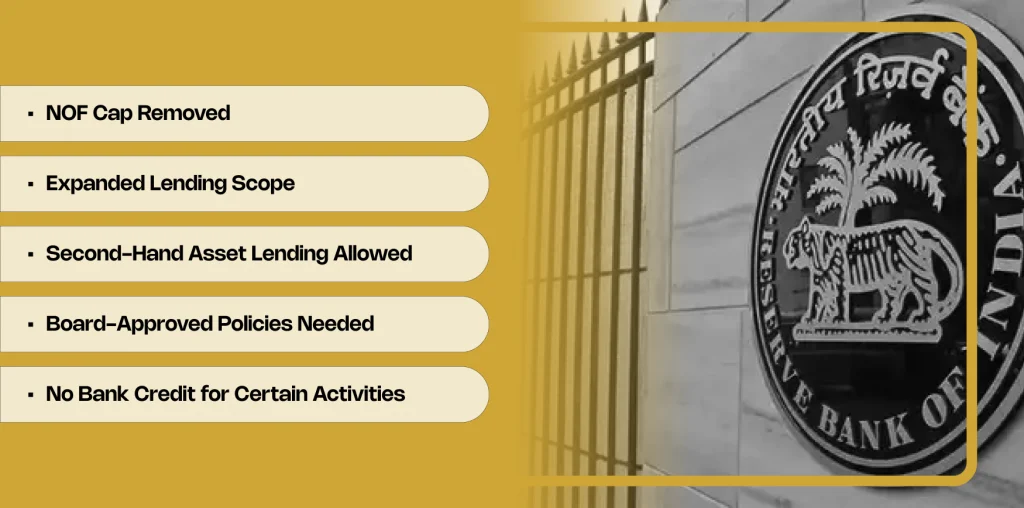
1) NOF cap removed
Earlier, bank lending to NBFCs was often evaluated with linkage to Net Owned Funds (NOF). The circular removes that linkage for RBI-registered NBFCs, pushing decisions toward risk profiling + prudential exposure management.
Why it matters: Funding capacity can scale faster—if your portfolio and end-use are clean.
2) Expanded lending scope
Banks may extend term loans / working capital to NBFCs engaged in permitted areas like infrastructure finance, hire purchase, equipment leasing, loans, factoring (subject to eligibility), and investments (within limits).
Keyword fit: This is a practical expansion for bank lending to NBFCs in asset-backed and structured credit models.
3) Second-hand asset lending allowed
NBFCs financing used assets (like used equipment or vehicles) can access bank funding secured against those assets.
Why it matters: This supports mainstream fintech growth segments like used-vehicle underwriting and resale-market credit.
4) Board-approved policies needed
Banks must frame Board-approved internal policies for NBFC exposure management—within RBI’s prudential framework.
What fintechs will feel: More partner documentation, tighter monitoring asks, and stronger audit trails.
5) No bank credit for certain activities
The circular explicitly restricts bank finance for certain end-uses—this is where deals get blocked if your structure looks like:
- capital markets-linked funding (IPO / secondary share purchases)
- unsecured inter-corporate style flows
- Lending to subsidiaries/group companies
- certain bill discounting patterns (with narrow exceptions)
Takeaway: Don’t treat this as legal text—treat it as product logic.
What This Means for Fintechs
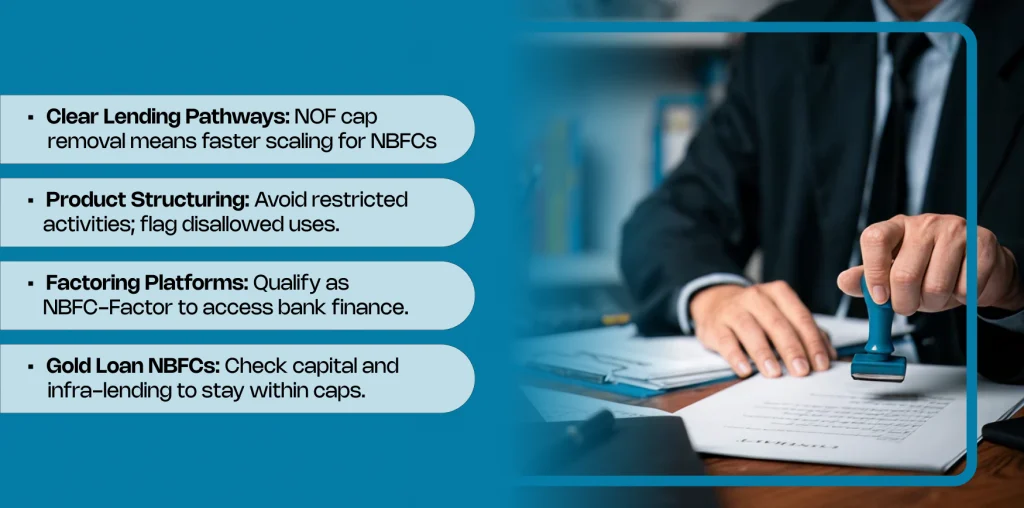
Clear lending pathways
With the NOF linkage removed, RBI bank finance to NBFCs can become smoother for well-governed NBFCs—especially in asset-backed lending, SME finance, and used-asset credit.
Product structuring needs guardrails
If your end-use can be interpreted as a restricted activity, your bank partner will slow down or decline. Build backend rules to:
- tag end-use categories
- block disallowed use-cases
- generate audit-friendly reasoning logs
Factoring platforms: qualify properly
If you’re in invoice discounting/receivables, you may need NBFC-Factor alignment (factoring income/asset thresholds + regulatory compliance) to access bank finance cleanly.
Keyword fit: This is where factoring rules and NBFC-Factor positioning decide your funding lane.
Gold loan NBFCs: watch exposure caps
Gold loan NBFCs often come with tighter bank exposure expectations (and internal bank limits). Ensure your capital, book mix, and infra-on-lending splits stay compliant to avoid partner rejection.
Keyword fit: Track NBFC exposure limits and the gold loan NBFC exposure cap at the partner level.
What to Do Next (simple checklist)
- Map your products to permitted end-use categories
- Identify flows that resemble restricted activities
- Add rule-engine checks (end-use flags + blocks)
- Track partner exposure ceilings (NBFC + group level)
- Align reporting with bank board-policy expectations
Need to sanity-check your lending flows against RBI bank finance to NBFCs rules—especially restricted end-use and exposure tracking?
BeFiSc can help teams operationalize compliance checks, monitor exposure patterns, and maintain audit-ready documentation.
Learn more with BeFiSc
FAQs
1) What is the RBI Master Circular on bank finance to NBFCs (April 2025)?
It is a consolidated RBI circular (effective April 1, 2025) that compiles all existing directions on RBI bank finance to NBFCs up to March 31, 2025—so banks and NBFCs have one clear reference.
2) Does the circular introduce new rules for bank lending to NBFCs?
As per the circular’s nature, it primarily consolidates existing guidelines rather than creating fresh ones. The major impact is clearer enforceability and cleaner interpretation for banks.
3) What lending end-uses are restricted under RBI bank finance to NBFCs?
Bank finance cannot be used for certain activities like capital market-related funding (e.g., IPO/secondary share purchases), unsecured inter-corporate style lending, lending to group companies/subsidiaries, and other specified restricted end-uses. Fintechs should hard-code these restrictions into workflows.
4) What should fintechs/NBFCs do immediately after this circular?
Audit product structures and end-use categories, build automated end-use checks, and set up exposure tracking—especially for NBFC exposure limits, group exposure aggregation, and special categories like gold loan NBFCs.