
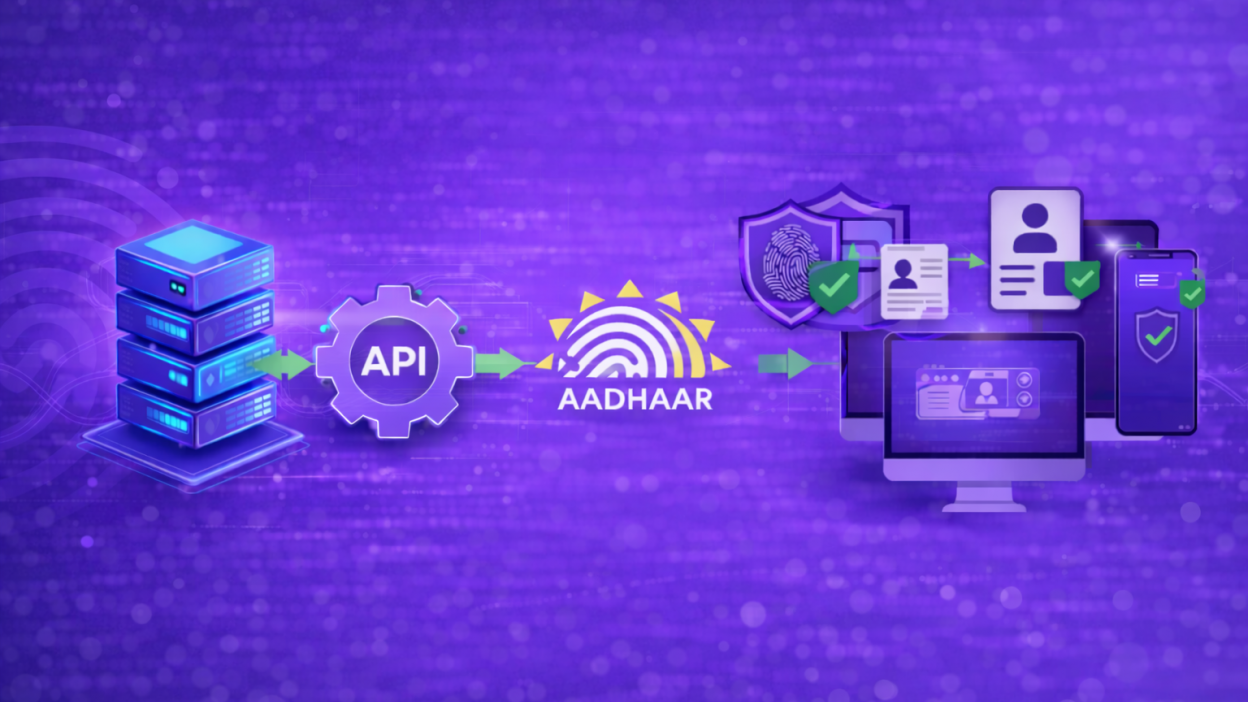
Why Aadhaar API Integration Is No Longer Optional for Indian Fintechs
If you are building a financial product, lending platform, or any identity-dependent service in India, you already know that Aadhaar-based verification is not just a convenience — it is the most reliable government-backed identity infrastructure available at scale.
With over 1.38 billion Aadhaar enrollments and millions of daily verification requests, integrating Aadhaar into your onboarding stack can reduce KYC turnaround from days to seconds. Additionally, it cuts manual verification costs significantly and helps you meet regulatory requirements set by the RBI, SEBI, and IRDAI.
However, the integration is not plug-and-play. Because UIDAI enforces strict compliance prerequisites, consent frameworks, and data-handling restrictions, every product and engineering team must understand these rules before going live. This guide walks you through the entire process — from API fundamentals to a production-ready verification flow.
Understanding Aadhaar Verification at the API Level
Before writing a single line of code, your team needs to understand what an Aadhaar card check actually means in technical and legal terms.
An Aadhaar card check is not a simple database lookup. Instead, it is a structured authentication or eKYC process that connects your system to UIDAI’s central infrastructure. The method you choose directly determines what data your system receives, what compliance obligations apply, and how you architect the onboarding flow.
| Method | Real-Time | Data Returned | Compliance Complexity |
|---|---|---|---|
| OTP-Based Aadhaar eKYC | Yes | Full demographics + photo | Medium |
| Offline Aadhaar XML | No | Locally validated signed data | Low |
| Aadhaar Card Number Check | Yes | Basic identity confirmation | Low |
OTP-Based Aadhaar eKYC is the most widely used flow in fintech onboarding. The user enters their Aadhaar number, UIDAI sends an OTP to the registered mobile, and on successful authentication, the system returns verified demographic data to your platform.
Offline XML Verification lets users download a digitally signed XML from the UIDAI portal and upload it directly to your platform. Because no live UIDAI call happens after upload, your backend validates the digital signature and parses the data locally.
Aadhaar Card Number Check via API Aggregators allows you to run a structured identity confirmation through UIDAI-authorized KUA and AUA providers. Since this approach avoids direct UIDAI connectivity, it remains the most practical entry point for most organizations.
Choosing the wrong method for your context creates downstream compliance and UX friction. Therefore, map your use case before you write a single API call.
Regulatory and Compliance Prerequisites
This is where most teams underestimate the groundwork. Since UIDAI does not permit arbitrary commercial entities to connect directly to its authentication infrastructure, every organization must operate within a defined legal framework.
AUA and KUA Registration: To run live Aadhaar authentication, your organization must hold Authentication User Agency status or operate as a sub-AUA under a licensed entity. Furthermore, for online Aadhaar eKYC that returns demographic data, KUA or sub-KUA status is required. Only regulated entities — banks, NBFCs, insurtechs — or their authorized technology partners can operate within this framework.
Sub-AUA Model: Because direct registration involves infrastructure audits and ongoing obligations, most fintechs integrate through a licensed API provider operating under an AUA or KUA license. This is the fastest, most audit-aligned route to production.
Consent Framework: UIDAI mandates that you capture explicit, informed user consent before any Aadhaar card check begins. Specifically, your platform must log the consent timestamp, link it to a transaction ID, and display UIDAI-prescribed consent language in a language the user understands. Since this becomes a compliance artifact during audits, treat it as critical infrastructure — not a UI checkbox.
Data Minimization and Retention: Aadhaar data cannot exceed what your operations strictly require. Additionally, biometric data must never enter your storage layer under any circumstances. Build these constraints into your architecture from the start because retrofitting them after a compliance review is expensive and disruptive.
Choosing the Right API Provider
This decision matters more than most teams realize. Because your provider determines your compliance posture, uptime reliability, and onboarding conversion rates, evaluating them carefully protects your business at every layer.
Most fintechs and NBFCs avoid pursuing direct AUA or KUA registration with UIDAI. Since the infrastructure requirements and ongoing audit obligations make direct registration impractical for all but the largest institutions, the smarter path is partnering with an authorized provider that absorbs regulatory complexity on your behalf.
When evaluating providers, focus on these four criteria:
UIDAI Authorization: First, confirm active AUA or KUA status. Any provider facilitating live Aadhaar eKYC without valid authorization exposes your business to regulatory risk — regardless of how polished their documentation looks.
Compliance Architecture: Additionally, look for providers that natively handle PID block encryption, consent logging, and audit trail generation. If you must build these compliance layers yourself, the provider is not enterprise-ready.
Uptime and Redundancy: Since UIDAI experiences both scheduled and unscheduled downtime, your provider must offer fallback mechanisms, failover logic, and transparent SLAs.
Data Handling Policies: Finally, confirm explicitly what your provider retains post-verification, for how long, and under what access controls. Providers who give vague answers here are providers to avoid.
This is precisely where BeFiSc is built differently. Because BeFiSc’s KYC API infrastructure is purpose-built for fintechs and NBFCs, it delivers fast, compliant, real-time identity verification without requiring your team to build regulatory infrastructure from scratch. From Aadhaar card check flows to multi-layered KYC orchestration, BeFiSc handles the compliance complexity so your engineering team can focus entirely on shipping product.
Step-by-Step Implementation Guide
Step 1: Define Your Verification Use Case
First, determine exactly what identity attributes you need and at what stage of your user journey. Because this decision shapes which API endpoints you call and what consent UI you build, map it out before opening a code editor.
Step 2: Set Up Your Development Environment
Register for a sandbox account with your chosen provider. Additionally, ensure your backend enforces HTTPS across all endpoints, uses TLS 1.2 or higher for outbound API calls, stores credentials securely via environment variables, and excludes raw Aadhaar numbers from all logs.
Step 3: Build the Consent Capture UI
Since UIDAI treats consent as a mandatory compliance artifact, your frontend must capture it before triggering any verification flow. Specifically, your system must log the consent timestamp, session ID, and approval transaction ID. Build this into your component library early — because retrofitting consent capture into a live product creates audit gaps that surface during regulatory reviews.
Step 4: Build the OTP Initiation Flow
Once a user submits their 12-digit Aadhaar number, your backend calls the provider’s initiation endpoint, which triggers OTP generation by UIDAI to the user’s registered mobile. A conceptual initiation request looks like this:
POST /aadhaar/initiate
{
  "aadhaar": "XXXXXXXXXXXX",
  "consent": true,
  "transaction_id": "txn_abc123"
}
Additionally, always mask the Aadhaar number after entry, implement rate limiting on this endpoint, and build clear handling for UIDAI-specific errors such as mobile not registered or OTP generation limits exceeded.
Step 5: Handle OTP Submission and Parse the Response
When the user submits the OTP, your backend calls the provider’s verification endpoint. A conceptual verification request:
POST /aadhaar/verify
{
  "aadhaar": "XXXXXXXXXXXX",
  "otp": "XXXXXX",
  "transaction_id": "txn_abc123"
}
On success, a signed payload returns demographic data in its Aadhaar-registered format, which often differs from what users enter manually. Therefore, normalize this data in your data layer before storing or displaying it. For full eKYC responses, the payload also includes a base64-encoded photo — store only what your business logic strictly requires.
Step 6: Validate the Digital Signature
For offline XML flows, validating UIDAI’s digital signature confirms that nobody has tampered with the document. Since UIDAI publishes its public keys, your backend must run this validation before trusting any data in the document. For online API responses, verify explicitly whether your provider handles signature validation at their layer or whether that responsibility falls to you.
Step 7: Build Structured Error Handling
Because Aadhaar card check API calls can fail for multiple reasons, you need a clear error taxonomy. Specifically, surface user-correctable errors like wrong or expired OTPs as actionable UI messages, trigger exponential backoff and ops alerts for system-level failures, and gracefully fall back to alternative KYC methods — such as DigiLocker or video KYC — for hard failures. Never expose raw UIDAI error codes directly to end users.
Step 8: Test End-to-End Before Going Live
Run complete tests covering successful eKYC verification, OTP failure and retry paths, consent capture and audit log validation, and load testing under concurrent volumes. Additionally, involve your compliance team in pre-production review — because catching gaps before launch is far cheaper than resolving them after.
Step 9: Monitor in Production
Once live, continuously track these metrics to keep your integration healthy:
| Metric | Why It Matters |
|---|---|
| API success and failure rate | Surfaces systemic issues early |
| Average response latency | Direct indicator of onboarding friction |
| OTP drop-off rate | UX signal for funnel optimization |
| UIDAI error code frequency | Indicates saturation or misuse patterns |
Set alerts for sudden failure spikes, because these often signal UIDAI downtime or emerging abuse patterns that require immediate attention.
Common Mistakes to Avoid
Teams that store raw Aadhaar numbers in application databases — even in encrypted form — create unnecessary regulatory exposure. Instead, use only masked versions or tokenized references throughout your system.
Many teams also ignore mobile-not-registered scenarios, which creates onboarding dead ends. Since a meaningful percentage of users — particularly in rural areas or older demographics — may not have their mobile linked to Aadhaar, your flow must offer an alternative path such as offline XML upload, DigiLocker verification, or video KYC.
Finally, failing to update consent language when UIDAI revises its guidelines is a recurring oversight that surfaces during audits. Therefore, subscribe to UIDAI circulars or your provider’s compliance update notifications so your team stays current without actively monitoring for changes.
Ready to Build a Faster, Compliant Onboarding Stack?
Your Aadhaar verification integration is only as strong as the API layer beneath it. If you are building for scale — reducing KYC drop-offs, cutting manual review costs, and staying ahead of UIDAI compliance requirements — the foundation you choose matters more than the features you build on top of it.
BeFiSc‘s KYC API is trusted by fintechs and NBFCs across India for real-time Aadhaar verification, online Aadhaar eKYC, and end-to-end identity checks that are secure, audit-ready, and built for production from day one.
Visit www.befisc.com to explore the API suite, sandbox documentation, and get your integration started today.
Frequently Asked Questions
1. What is the difference between Aadhaar authentication and Aadhaar eKYC?
Aadhaar authentication confirms that a given Aadhaar number and credentials are valid, but returns only a yes or no response. Aadhaar eKYC, however, goes further — it returns verified demographic data, including name, address, date of birth, and photo directly from UIDAI’s records. Because most fintech onboarding flows require verified identity attributes, full eKYC is typically the right choice over simple authentication.
2. Can any company integrate directly with UIDAI for an Aadhaar card check?
No. Direct integration requires formal AUA or KUA registration, which involves infrastructure audits, legal agreements, and ongoing compliance obligations. Since these requirements make direct registration impractical for most fintechs, integrating through a licensed API provider is the most efficient and compliant path available.
3. Is OTP-based online Aadhaar eKYC valid for RBI-mandated KYC compliance?
Yes, it is a UIDAI-supported and RBI-recognized verification method for eligible financial services. However, sector-specific rules apply. Therefore, always verify the applicable RBI circular for your product category before relying solely on eKYC as your compliance pathway.
4. What happens if a user’s mobile number is not linked to Aadhaar during the Aadhaar card number check?
Because the OTP goes to the UIDAI-registered mobile number, delivery fails if the number is not linked. As a result, your onboarding flow must offer alternative paths — such as offline XML upload, DigiLocker verification, or video KYC — to avoid drop-offs for this user segment.
5. How should Aadhaar data be stored after a successful verification?
Since UIDAI prohibits storing raw Aadhaar numbers, retain only data strictly necessary for your use case, in encrypted form, with access controls and audit logs in place. Additionally, biometric data must never enter your storage layer under any circumstances. Use tokenized or masked references for the Aadhaar number, and align your retention policy with both UIDAI guidelines and applicable data protection regulations.