

Gold Monetization Scheme rules changed on March 26, 2025, after the Government of India and the RBI discontinued Medium and Long Term Government Deposits (MLTGD) under the scheme.
With this update to the Gold Monetization Scheme, only Short Term Bank Deposits (STBD) may continue—at banks’ discretion—while existing MLTGD accounts will run till maturity with no renewals allowed.
If your fintech product touches gold savings, wealth-tech, lending, or bank integrations, this update requires immediate product and compliance action.
What Changed in March 2025
Until now, GMS allowed gold deposits across three tenures. However, that structure has now been simplified.
From March 26, 2025:
- MLTGD has been discontinued for all new and renewal cases
- Existing deposits remain valid until maturity
- STBD may continue, but only if a bank chooses to offer it
In effect, long-tenure government-backed gold deposits are no longer part of India’s gold monetization strategy.
Why the Government Is Phasing Out Long-Term Gold Deposits
The Gold Monetization Scheme was introduced in 2015 with a clear objective: bring idle gold held by households and institutions into the formal financial system. By doing so, the government aimed to reduce dependence on gold imports and manage pressure on the current account deficit.
Originally, the scheme offered:
- STBD: 1–3 years (bank-managed)
- MTGD: 5–7 years (government-backed)
- LTGD: 12–15 years (government-backed)
Over time, however, MLTGDs saw limited adoption. Long tenures, lower flexibility, and complex servicing made them less attractive to depositors. At the same time, they increased operational and fiscal overhead for both banks and the government.
Therefore, in 2025, policymakers chose to narrow the scheme’s scope, focusing instead on simpler, bank-led deposits.
Key Highlights Fintechs and Banks Should Note
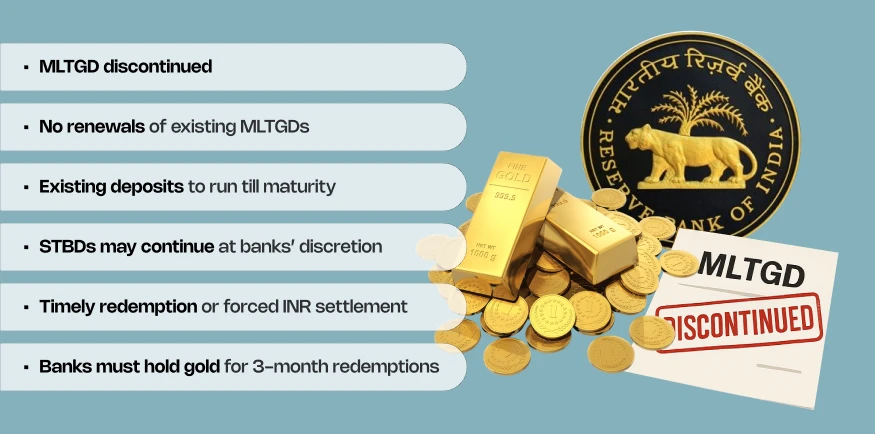
- MLTGD discontinued: No fresh medium or long-term gold deposits accepted after March 26, 2025
- Renewals blocked: Existing MLTGDs cannot be renewed after March 25, 2025
- Existing deposits continue: All eligible deposits will run till maturity
- STBD optional: Banks may offer STBDs, but there is no obligation
- Redemption discipline tightened: Late redemption may result in forced INR settlement
- Gold stock requirement: Banks must hold physical gold for redemptions due within three months
In short, gold deposits now move toward shorter tenure, higher liquidity, and bank-managed risk.
Why This Matters Now
This change is not isolated. Instead, it aligns with broader policy goals.
First, it simplifies how gold deposit products are administered. Second, it reduces long-term fiscal exposure for the government. Finally, it encourages banks and fintechs to work with more liquid, transparent instruments.
Meanwhile, consumer behavior around gold is also evolving. Digital gold, ETFs, and app-based savings products are gaining traction, making long-term physical gold deposits less relevant.
Impact on Fintechs: What You Must Do
1) Remove MLTGD Options Immediately
Any fintech still displaying or enabling MLTGD flows must disable them at once. This includes onboarding journeys, renewal logic, and backend configurations.
2) Audit Existing Customer Flows
Additionally, ensure that:
- No new MLTGD accounts are created
- Renewals are blocked post-cutoff
- Receipt-date logic aligns with RBI rules
3) Update Customer Communication
Clear communication is critical. Users holding gold-linked products must understand what has changed, what remains active, and what alternatives exist.
4) Reposition STBD Where Applicable
Since STBDs are optional, fintechs should confirm availability with partner banks. If offered, products can be repositioned around:
- Short tenures
- Predictable redemption
- Simpler disclosures
5) Strengthen KYC and Compliance
Importantly, revised GMS directions reaffirm strict KYC requirements. Any gold-linked onboarding flow must remain compliant and audit-ready.
Broader Market Implications

For Banks
With MLTGD discontinued, banks now retain gold risk for STBDs. At the same time, operational complexity reduces significantly. However, liquidity planning becomes more important, especially for near-term redemptions.
For Investors
Investors will see fewer long-tenure gold deposit options. Consequently, demand may shift toward digital gold, ETFs, or sovereign gold bonds.
For Government
From a policy perspective, the move reduces long-term servicing obligations while improving regulatory clarity and oversight.
Where BeFiSc Fits In
As the Gold Monetization Scheme changes reshape gold-linked products, fintechs must adapt without introducing compliance gaps.
BeFiSc supports fintechs and banks by:
- Aligning gold-product flows with updated RBI rules
- Strengthening KYC and audit trails
- Ensuring regulator-ready documentation
- Reducing risk during product or API changes
Put simply, BeFiSc helps teams move fast—without losing regulatory control.
Actionable Checklist for Fintech Teams
✅ Disable MLTGD products immediately
✅ Update onboarding, renewal, and redemption logic
✅ Refresh T&Cs and disclosures
✅ Communicate changes clearly to users
✅ Validate STBD availability with banks
✅ Monitor RBI FAQ updates
✅ Explore alternative gold instruments
Deadline to Remember
- March 25, 2025: Last day for MLTGD acceptance or renewal
- March 26, 2025: Updated GMS rules come into force
Conclusion
Overall, the latest Gold Monetization Scheme changes reflect a clear policy shift toward simplicity, liquidity, and bank-managed responsibility.
For fintechs, this is not merely a compliance update. Instead, it is an opportunity to redesign gold products that are clearer, shorter-term, and more transparent. Those who adapt early will be better positioned as India’s gold ecosystem continues to modernize.
Need help updating gold investment flows or bank integrations?
Talk to BeFiSc.
FAQs
What has changed under the Gold Monetization Scheme in 2025?
The RBI has discontinued Medium and Long Term Government Deposits (MLTGD) under the Gold Monetization Scheme from March 26, 2025. Only Short Term Bank Deposits (STBD) may continue, at the banks’ discretion.
Can existing MLTGD accounts still continue?
Yes. All MLTGD accounts opened on or before March 25, 2025, will continue under existing rules until maturity. However, renewals or fresh deposits are no longer permitted.
Are banks required to offer Short Term Bank Deposits under GMS?
No. Offering STBDs under the Gold Monetization Scheme is optional. Each bank can decide whether or not to continue these deposits based on its own risk and operational considerations.
How do the Gold Monetization Scheme changes affect fintech platforms?
Fintechs must immediately stop offering MLTGD products, update user flows and disclosures, ensure KYC compliance, and clearly communicate the changes to customers using gold-linked savings or investment products.