

SEBI master circular on stockbrokers (June 2025) explains exactly how investors can raise complaints, escalate via SCORES, and track resolution timelines.
That’s why the SEBI master circular on stockbrokers matters.
On June 17, 2025, SEBI strengthened the grievance framework for stockbrokers and made the complaint route clearer. In this blog, you’ll learn exactly how to file a complaint, how to escalate it, and what timelines you can expect.
Why does this matter under the SEBI master circular on stockbrokers

SEBI wants complaints to move faster and more predictably. So the circular pushes three clear outcomes:
- Faster, more transparent redressal
You shouldn’t have to guess where your complaint is stuck. - More accountability for stockbrokers
Brokers must own the grievance process, not treat it like “support backlog.” - Better investor awareness
SEBI expects brokers to make the complaint route easy to find and easy to use.
In other words, SEBI is not just setting rules. It is making brokers show investors the path—and follow it.
The stockbroker complaint process: step-by-step escalation
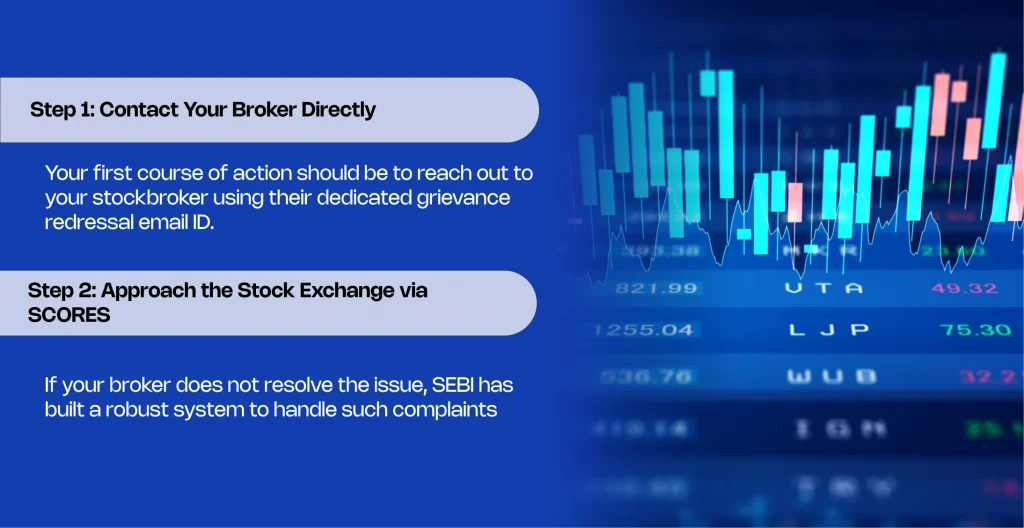
Step 1: Email your broker first (use the grievance email ID)
Start with your broker’s dedicated grievance redressal email ID. SEBI expects brokers to publish it clearly, so you should find it without much effort.
To get quicker action, write your complaint like this:
- 1–2 lines: what went wrong and when
- your client code/account details
- proof: contract notes, ledger statement, screenshots, email trail
Also, keep your message calm and factual. That helps the broker’s compliance team resolve it faster.
Step 2: If the broker delays, escalate via SCORES
If the broker does not resolve the issue—or gives an unsatisfactory response—move to SCORES (SEBI Complaints Redress System).
SCORES helps because it:
- creates a formal record of your complaint
- routes it through the stock exchange mechanism
- improves traceability and accountability
So instead of chasing multiple contacts, you follow one structured path.
Complaint timelines investors should track
Timelines matter because they reduce uncertainty. They also keep complaints from drifting.
From the summary you shared:
- 15 working days: the stock exchange should ensure resolution within this period
- 7 working days: if more information is needed, the broker/exchange should ask within this time
So, if you don’t hear back, you can follow up with confidence—because you know what to expect.
Practical tips that make complaints stronger
Most complaints fail because they are vague. So do this instead:
- Be specific: mention the date, time, and transaction reference
- Attach evidence early: contract note, ledger, screenshots
- Use the official grievance email ID: avoid generic support channels
- Keep your own record: save emails, acknowledgements, and submissions
- Escalate on time: if the broker stalls, move to SCORES
As a result, your complaint looks credible, complete, and easy to action.
Recap: key takeaways from the SEBI master circular on stockbrokers
Here’s what investors should remember:
- Brokers must provide a dedicated grievance email ID
- Brokers must make it visible across the website and investor communications
- Investors can escalate via SCORES if the broker does not resolve the issue
- defined timelines create speed + accountability
In short: SEBI is making complaint handling simpler, clearer, and harder to ignore.
If you’re a fintech or market intermediary, don’t treat grievance redressal as manual ops. Instead, build it like a workflow: clear routes, logs, and timeline tracking.
BeFiSc helps teams operationalise compliance-ready processes with monitoring and audit-friendly reporting.
Learn more: www.befisc.com
FAQs
1) What is the SEBI master circular on stockbrokers (June 2025)?
It is SEBI’s updated framework that clarifies stockbroker compliance requirements, including how brokers must handle investor grievances and complaint visibility.
2) How do I file a complaint against a stockbroker?
First, email the broker using their dedicated grievance redressal email ID. Then, share details and proof so the complaint reaches the compliance/grievance team directly.
3) What is SCORES, and when should I use it?
SCORES is SEBI’s online complaint system. Use it when your broker delays resolution or does not resolve the issue properly, so you can escalate through a structured route.
4) How long does complaint resolution take?
Based on the summary shared, resolution is expected within defined timelines (for example, around 15 working days for resolution and 7 working days to request additional info, if needed).